
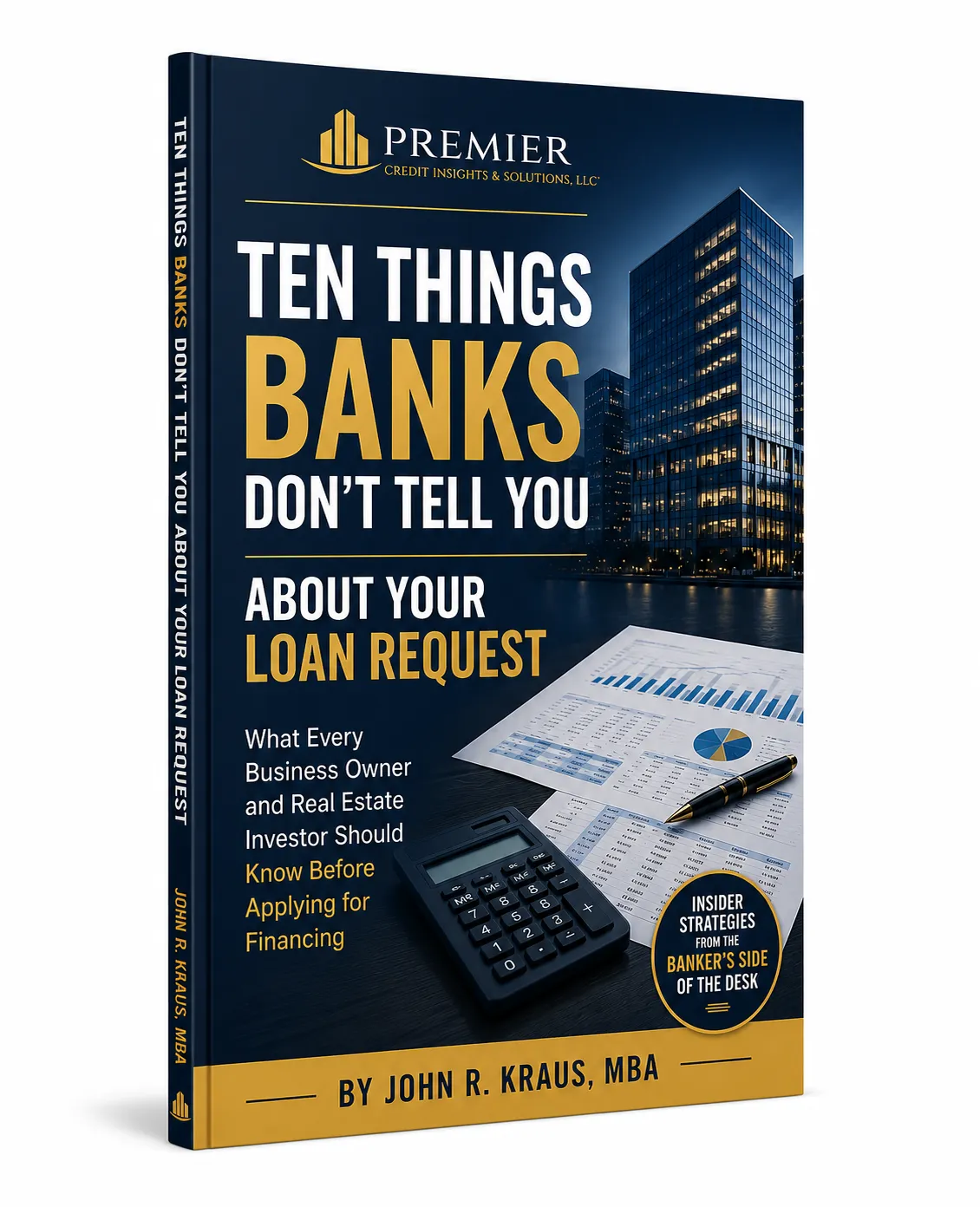
Ten Things Banks Don't Tell You About Your Loan Request
Learn how lenders evaluate financing requests and discover the common mistakes that can prevent businesses from getting approved.
Does this sound familiar?
You applied for financing and got a vague "no" — with no real explanation.
Your bank keeps asking for more documents, and you're not sure why.
You got approved, but you're not sure if the terms, rate, or structure were actually the best you could have gotten.
You're profitable on paper, but your bank doesn't seem to see it that way.
Most business owners only find out how banks really think after they've already been turned down — or locked into a deal that isn't structured in their favor.
This guide pulls back the curtain, based on 40+ years of sitting on the other side of the desk.
What You'll Learn Inside
Why profit doesn't equal cash flow, and why lenders care more about one than the other
How your tax returns could be hurting your borrowing capacity without you realizing it
Why your personal finances matter, even when you're borrowing through your business
The difference between why you need the money and how a lender wants you to use it
How banks actually underwrite your loan, the stress tests, adjustments, and qualitative factors most borrowers never see
Why collateral and personal guarantees aren't enough to get you approved
Why the lowest rate isn't always the best deal
What makes financial projections credible in a lender's eyes
Why loan structure matters as much as approval
How the strongest borrowers prepare long before they ever apply

About John
John Kraus spent more than four decades in commercial banking and credit administration, reviewing thousands of commercial loan requests and participating in lending decisions ranging from small business lines of credit to complex commercial real estate and construction loans. Today, through Premier Credit Insights & Solutions, he helps business owners, contractors, real estate investors, and developers understand lender expectations, strengthen their financing requests, and walk into the bank with confidence.
Preserving Working Capital for Growth
A specialty commercial fencing contractor needed a larger warehouse to support its continued growth. Rather than using conventional financing that required a significant equity contribution, John recommended an SBA 504 loan structure with a lower down payment and an expanded operating line of credit.
Result: The company preserved working capital, maintained healthy cash flow, and continued growing with a financing structure aligned to its long-term goals.
Structuring Financing the Right Way
A highway contractor supplier wanted to use its working capital line of credit to purchase rental equipment. John recommended separating the financing into two facilities—one for working capital and another for fixed assets.
Result: The company preserved liquidity, matched loan payments to rental income, and created a financing structure that supported continued expansion.
"I spent over 40 years approving.. and declining.. commercial loans. I wrote this guide because I kept seeing good business owners get turned down, or approved on bad terms, simply because no one ever explained how the process actually works from the bank's side."
~ John R. Kraus, MBA
Ready to See Your Financing Request Through a Banker's Eyes?
No sales pressure, just practical guidance from someone who spent 40+ years on the lender's side of the table.
Common Questions
Do I need to be actively applying for a loan right now to benefit from this guide?
No. Many of the strongest borrowers start preparing 60–90 days (or more) before they ever apply. This guide is just as useful if you're planning ahead as it is if you're mid-process.
Is this only for large businesses or big loan requests?
No. The principles apply whether you're seeking a small business line of credit or a complex commercial real estate loan.
Is there any cost or obligation to download the guide?
No. It's completely free, with no obligation. If you'd like to go further, a complimentary 30-minute Bank Readiness Consultation is available.
Before You Apply for Financing, Read This First
No sales pressure, just practical guidance from someone who spent 40+ years on the lender's side of the table.